
The all-too-familiar term, “spam”, but nope, we’re not talking about that luncheon meat you eat.
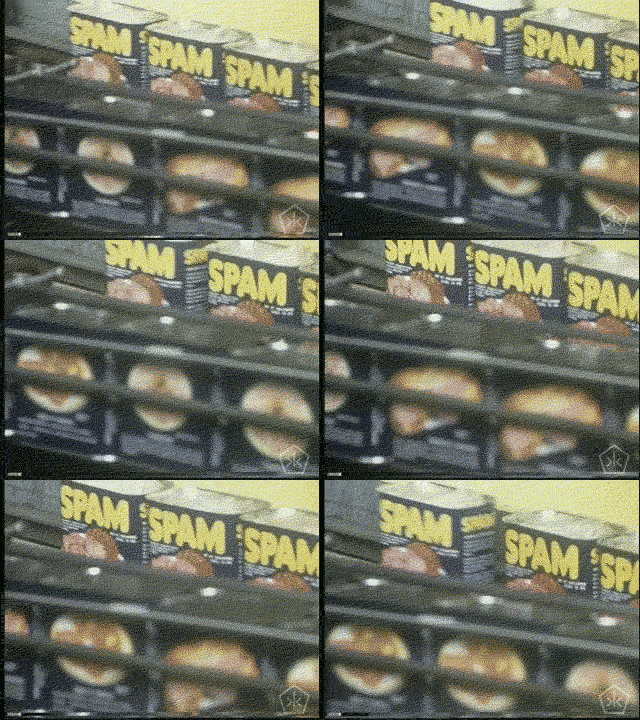
We’re going into the kind of spam that pretty much makes you go a little like… this.

Can’t deny that it is part and parcel of the digital world we live in today, eh? Somehow or another, we inevitably become victims of spam at some point of our lives, even with the implementations and improvements in anti-spam technology.
But first, ever wondered how the term “spam” even came about? Well, here’s the story.
The term is derived from a well-known Monty Python sketch set in a cafe where the luncheon meat is featured in almost every dish. As the waitress describes the menu with increasing usage of the word “spam,” a group of Vikings in the cafe start singing, “Spam, spam, spam, the word “spam,” drowning out all other communication with their irrelevant, repetitive song.

And there we have it, the term “spam” to describe the unsolicited commercial email and related undesirable online communication we receive as this form of spam literally drowns out actual, relevant content we may want to view as well.
Consequences of Spam
Increasing Consumer Discontentment
As the global internet connectivity rises, e-mail constitutes one of the leading digital marketing means since 2014. However, with the prevalence of spam, there is growing discontentment within consumers due to their increasing difficulty to find what is relevant, useful, or enjoyable for themselves with the glut of information, almost literally shoved in their faces via e-mail. I mean, think about it. As the volume of words and images available grows exponentially at a rate that is much faster than the number of recipients and the time they can devote to process the information, how much information go wasted because of the higher proportion of information that goes unread and unattended?
(Talk about not being a broken telephone, the channel by which the message is encoded and decoded through, is important after all.)
Hidden Costs for Consumers
Apart from the time wasted from filtering through spam, the indirect consequence of spam is the costs of server hardware consumers have to bear, since spam causes it to require more than five times as much capacity as would be required in the absence of spam. Well, it is estimated that only 1.2% of 90 billion spam messages sent daily worldwide get through to the consumer. Yet this totals up to a worldwide end-user cost of spam to nearly $14 billion per year.

Short-term Cost Savings, Long-term Diminished Brand Image Perceived by Consumers
Spam threatens e-mail marketing’s reliability and efficiency as a mean of communication over the Internet with its rapid growth. There is a (literal) price to pay for that.

Albeit short-term cost savings of spam advertising as compared to other means, given that e-mail is a platform where businesses can communicate brand value proposition to desired target audience, and enable customers to likewise communicate their needs to the businesses, the diminished brand image created when consumers receive endless spam content from companies will poorly affect the long-term brand perception and consumers’ confidence in the brand.
Effective communication via e-mail increases revenue to the firm through increased awareness, performance and customer conversions; increased traffic to websites, locations or call centers; and deepened customer relationships and engagement. Thus, this also means that in the long run, firms that devote themselves to save costs using spam advertising will end up facing consequences for their actions since they reflect poor communication with their consumers in doing so.
In my opinion, overall, not such a fair trade after all when consumers turn away from such brands when information is missed out on or poorly communicated due to the influx of spam, huh? I would think that brands in general should flee from spam and focus instead on quality content marketing to attract the right people, at the right time, with the right content because this builds brand confidence and induces re-visits rather than drive consumers away.
With that said, kudos to the firms in the webmail service industry that try to combat these spam content (quite successfully, in my opinion) as they invest in spam prevention services to reduce the burden on end users. The most successful companies being the “Big Threes”, Yahoo! Mail, Microsoft Hotmail, and Google
Gmail, which have large, dedicated anti-spam and customer support teams– so much so that small webmail services simply cannot compete as the three-firm concentration ratio has increased significantly to about 85% between 2007 to 2012.
I certainly look to spam with more of a negative connotation than positive, and should not be utilised by companies in general. I mean, the sad truth is indeed that the costs of spam outweighs its benefits drastically, at an astounding ratio of 100:1! What do you think?
Chloe















 perspectives