
Ever find yourself having burning questions that you cannot wait to be answered?
You approach a friend, hoping he’d have an answer to them, only to have him say…
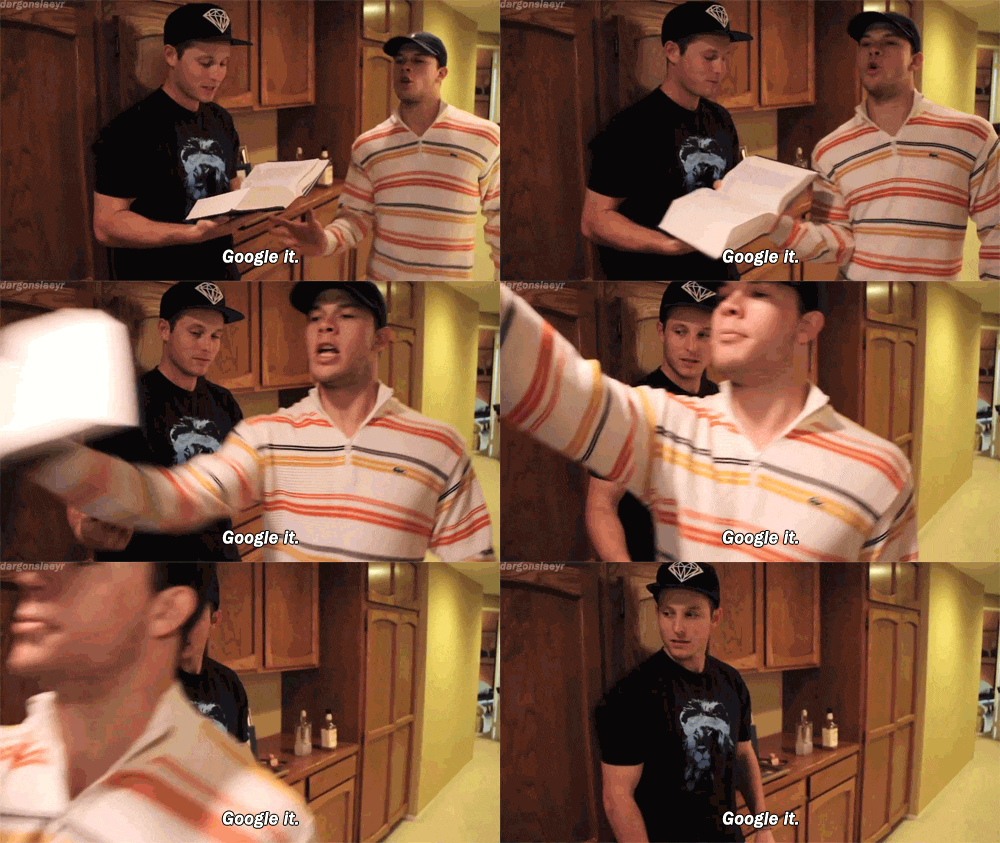
Familiar scenario, huh? Google has inevitably “replaced” our brains to become our go-to encyclopedia that can literally answer most, if not all, the burning questions of our hearts. Best of all, within a fraction of a second. Fast like the Flash, eh?

Interesting to note, however, that Google isn’t the only search engine lurking around on the Internet. Yet, they somehow manage to make up a solid 95.67% market share on mobile and tablet devices.

But yes, let’s talk about Google. From finding out what your IP address is, to the restaurants nearest to your current location, there is almost nothing that Google cannot tell you today. Here, take a look at the Top 10 Most Asked Questions on Google:

Crazy, huh? Down to the most minute questions, people are asking Google for an answer! This brings me to my point that with Google playing such an pivotal role in the lives of the Digital dwellers today as on-line search volume continues to grow at 10–20 percent per year, search engine marketing is arguably absolutely necessary as marketers are seeking to improve their visibility in the “search results” provided to potential consumers.
Search Engine Marketing (SEM) and its Techniques
First of all, Chaffey et al. defines SEM as “promoting an organisation through search engines to meet its objectives by delivering relevant content in the search listings for searchers and encouraging them to click through to a destination site”. How, you may ask? Through two key techniques, mainly Search Engine Optimisation (SEO) and Paid Search Marketing (PPC).
What is SEO and PPC?
SEO is a marketing approach focused on improving visibility in organic (non-paid) search engine results. Simply put, SEO drives traffic to one’s website by improving the rankings according to the site’s content, services and links.
On the other hand, PPC, otherwise known as “Pay-Per-Click” is a relevant text ad with a link to a company page displayed on the search engine ranking pages when the user types in a particular phrase. As the term implies, a fee is charged for every click of each link, with the amount bid per click determining its position.
Knowing these definitions, therein lies the question all marketers would be curious about… which should we invest in? (Should we invest in both, or should we even invest at all?)
Advantages and Disadvantages of SEO and PPC

Even with the advantages and disadvantages laid out, it might potentially still be slightly confusing what might be the best between the two.
Down to the User?
My personal take is that it boils back down to how the marketer chooses to optimise either of the strategies to drive traffic to their site.
Using Black & White Hat Techniques (SEO)
For example, when using SEO, using black hat techniques such as keyword stuffing and invisible texts to deceptively increase a site’s page ranking will end up doing the company more harm than good in the long run. It is neither ethical nor effective because of the poor content within the site itself that will not be appealing to users even after they have clicked on the site. Conversely, the usage of proper white hat techniques to improve readability, content relevance, well-designed structure and well-written content will certainly ensure results.
Using Key Strategies for Optimisation (PPC)
In the same way, PPC can only be effective and enhanced should the marketer optimise its usage through proper targeting, budgeting, creative testing and campaign optimisation, as well as through IMC integrations such as combining the use of PPC with SEO and offline campaigns. I certainly agree most with the IMC integrations because in today’s digital world, engagement is key to the hearts of the consumers. An all-rounded experience digitally and physically would certainly drive traffic!
My opinions aside, a food for thought on the Optimal SEM Strategy as I had asked earlier.. According to Sen’s paper on Optimal Search Engine Marketing Strategy, all 4 options (Do Nothing, Just SEO, Just PSM, and Both) were thoroughly weighed appropriately and the conclusion was that “even if the total cost of implementing SEO and implementing paid placement was the same, and SEO always resulted in a high ranking on the search results page, paid placement would still prevail as the SEM strategy of choice for most on-line sellers.”
What is your take on what might be the best technique to SEM? Would love to hear your perspectives in the comments below!
Chloe
 perspectives
Great read! From my perspective, I would think that even without the perks of having your website featured higher on the search results, it is important for a well-designed website to have good readability and website navigation for customers who are interested in your products/services. This would in turn decrease the bounce rate and improve on session durations.
To add on, I would think there should be a good mix of the two approaches to maximize the reach to customers
LikeLike
Enjoyable read Chloe! Interesting to note the statistics and facts that you have presented. Although what caught my attention the most was your last paragraph about how Paid-Placement was still the go-to choice for online sellers. I’d probably think that online businesses perhaps would not have the resources to spend much time optimising their web-pages for the purpose of SEO. So a one time payment for a good placement on result pages may seem like a good alternative! I do think that this is somewhat naive per se? I do feel that while this may work in the short-term, online businesses would have to consider what they can do different in order to stand out from the rest, especially if their competitors are aggressive themselves and so paid placement may not be the way to go in the long run. SEO would be a better choice, in this case, imo.
LikeLike
That was a really comprehensive article, awesome stuff Chloe! Personally, I never ever click on the PPC ads that show up right at the top of my searches. Even though they are the most immediate and visible, I find them unreliable and not a true representation of the most popular searches that internet users are clicking on. SEO would be a better strategy to build long-term visibility and garner more clicks.
Ladyironchef, a really popular local food blogger, capitalised on SEO in the early days of blogging and was able to push the ranking of his site higher and multiple searches. Considering how he is still one of the biggest food bloggers, I’d say that SEO is definitely paying off for him.
LikeLike
Very interesting Chloe!! I never really paid much attention or thought to finding out what kind of advertising techniques search engines use these days. I would think that PPC is the kind of SEM that is rather not useful to me. Moreover when I see these type of advertisements I would have the tendency to think that they are some form of click bait, virus or simply a waste of time. Mostly I feel they are irrelevant as well. SEM is definitely better in my opinion since it is highly targeted. To me, an advertisement or marketing strategy is successful when they have properly identified their target audience who will make up the biggest portion of their consumers. SEM seems to do a better job at this, compared to PPC.
LikeLike
SEO * (sorry I made a typo!)
LikeLike
This has been an interesting read and I am enlightened by the different ways of search engine marketing. I tend to click on the first few links that pop up first when I do a Google search as they are usually relevant. I believe that this is part of the SEO strategy as it analyses the contents of the webpage and determines its relevance before arranging the links in descending rankings. This is a successful strategy as it allows me to find what I am searching for in the shortest amount of time. On the other hand, I often avoid advertisements as they are commonly associated with virus or click-bait. Hence, I feel that PPC strategy may not be useful if people avoid the advertisements even if they are highly targeted and relevant. I understand that SEO requires a lot of effort and it takes time to show results but I feel that this strategy is sustainable and has higher chance of success.
LikeLike
Good read! Really shows how technology has evolved to enable us access to so much information at our disposal, all just a few clicks away.
PPC really does seem to be a pay-to-win method of increasing view count, and it no doubt casts a larger net to catch potential consumers, but the cons carried could cause costs to outweigh the benefits of implementing such a marketing strategy. I personally feel that the most efficient method is a combination of both techniques, as I find that the ads could possibly compliment the SEO technique if people notice the same site twice at the top of the search page, and increase the probability of consumers entering the site. An added bonus is that users may click the non-ad link to access the same page, saving the company precious resources. I’d say to be able to utilize both SEO and PPC skillfully would be the optimum strategy.
LikeLike